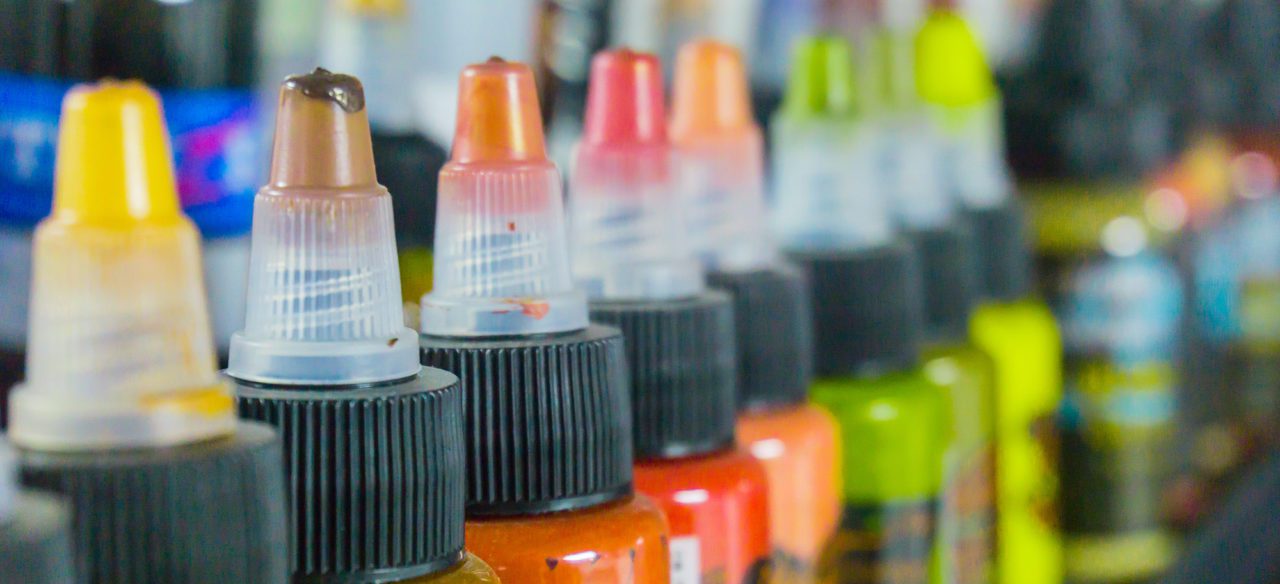
Tattoo Ink Chemicals and European Regulations
Tattoos are becoming increasingly common across Europe. Currently 12% of Europeans and 24% of United States’ citizens have tattoos or permanent make-up (PMU). The inks used are mixtures of chemicals that are inserted into the body and may stay there for life. Because of their nature long-term exposure to harmful chemicals in tattoo inks is a very real risk.
In some cases, it has been found that pigments produced solely for tattoo inks and PMU applications contain a low purity. Over 80% of colourants use organic chemistry and over 60% use azo-pigments that have carcinogenic properties through the release of aromatic amines.
A report on the Safety of Tattoos and Permanent Make-Up from the European Commission stated that a number of tattoo inks which were available on the European Market contained hazardous chemicals in high concentrations, such as:
Some tattoo inks were also found to contain microbiological contamination at 11% concentration.
Despite the potential dangers there is no EU-wide legislation specifically governing the content of tattoo inks or PMU products. Seven EU member states have chosen to introduce national legislation based on the non-binding Council of Europe Resolution on the on requirements and criteria for the safety of tattoos and permanent make-up ResAP(2008)1. The EU member states include:
Non-specifically these products: need to be deemed safe under the General Product Safety Directive; must comply with the Classification, Labelling and Packing Regulation; and follow any registration and information requirements under REACH.
After an extensive study into the dangers of tattoo inks and permanent make-up ECHA has determined a need for a specific legislation regarding the content of these products.
How can you test the chemicals in tattoo inks?
The chemicals that are used to make the supplied formulations that go into manufacturing of tattoo inks can undergo MRSL testing. This form of testing is referred to as MRSL testing and can be conducted by manufacturers and chemical companies.
Find out more about MRSL testing services as part of Chem-MAP®.
Contact the Chem-MAP® Team Today
If you are concerned about chemicals in your supply chain and want to develop chemical management in your business, contact a member of the Chem-MAP® Team today via info@chem-map.com or call us on +44 (0) 1604 679 999.
Eurofins | Chem-MAP is proud to announce that Syn-Bios S.p.A has successfully maintained its ZDHC Level 3 status under the latest ZDHC MRSL V3.1 guidelines. This milestone was accomplished in full compliance with Eurofins | Chem-MAP Protocol 5.0 and the latest ZDHC conformity guidelines. “Syn-Bios S.p.A has been a trusted...
Published 13th October 2025 Read more


Eurofins | Chem-MAP® is a brand of
Eurofins | BLC Leather Technology Centre Ltd.

© Copyright Eurofins | BLC Leather Technology Centre Ltd. 2026. All rights reserved.
 Contact Us
 chemmap@cpt.eurofinseu.com
 +44 (0) 1604 679 999